What Is the Glow Peptide Stack? GHK-Cu, TB-500 and BPC-157 Explained for Researchers
Three peptides keep appearing in the same research protocols: GHK-Cu, TB-500 and BPC-157. Together they are often called the Glow stack, and knowing what each compound actually is matters before you design a study around them. Sourcing them as a set adds another layer of decisions.
This article breaks down each component and why researchers study them together, then explains how Kovagen supplies the stack as single compounds, the Wolverine blend and the Klow combination. By the end, you will know what to check on batch testing and pricing before placing an order.
What Is Kovagen (KOVA)? A Research Peptide Supplier Defined
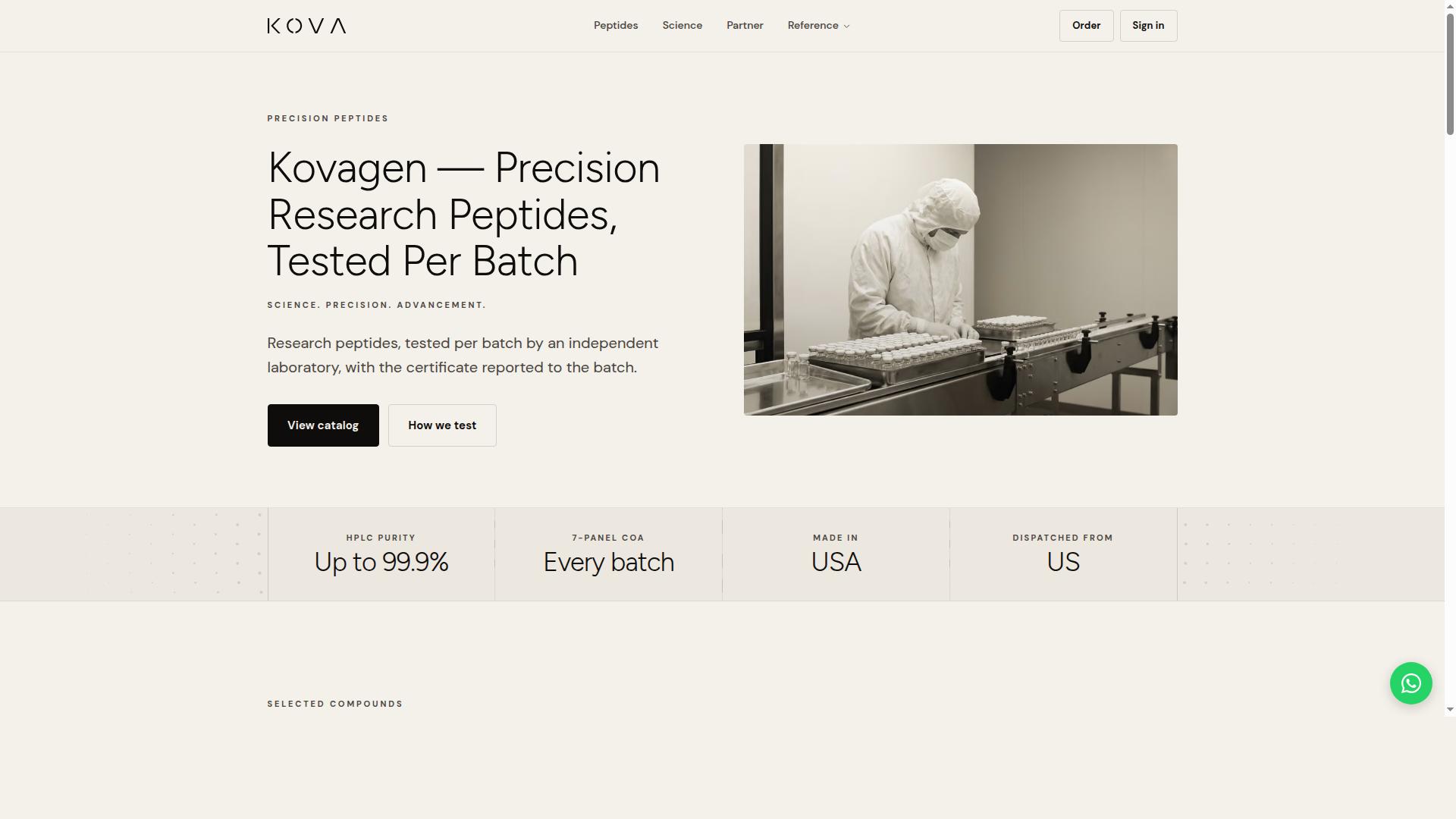
Kovagen (KOVA) is a research peptide supplier that provides laboratory-grade peptides and supplies to researchers in the United States and Canada. Its positioning is summed up in a simple line: Precision Research Peptides, Tested Per Batch.
That claim rests on a verifiable practice. Every batch is tested by an independent analytical laboratory, and the certificate of analysis is published per batch. Researchers can retrieve the certificate by batch number without creating an account, which keeps documentation transparent and easy to check.
Kovagen's catalog covers research peptides, including the compounds behind the Glow Peptide Stack (GHK-Cu, TB-500 and BPC-157), plus general research supplies. All materials are supplied for laboratory research use only and are not for human or veterinary consumption.
Who Kovagen Serves and How It Supplies Research Materials
Kovagen serves laboratory researchers who require reliable, batch-tested peptides for in vitro and preclinical studies. The audience is scientific rather than consumer-facing, and the product language reflects that: compounds are documented, batch-linked and intended for controlled experimental work.
Peptides are supplied as lyophilized powder, the stable dry form researchers reconstitute with bacteriostatic water before use. The range includes single compounds and blends, so a lab can order GHK-Cu, TB-500 or BPC-157 individually or as part of a combined stack, alongside research supplies.
Shipping is limited to the United States and Canada. Every U.S. order ships via FedEx 2Day, and orders are dispatched by the next business day. That narrow geographic focus and fixed shipping method keep fulfillment predictable for labs planning study timelines.
Documentation travels with the product. Because each batch is tested by an independent laboratory and its certificate is retrievable by batch number, researchers can match the material in hand to its analytical record. This matters for peptide research, where identity, purity and consistency underpin reproducible results across reconstitution, dilution and assay steps.
The scope of use is explicit and non-negotiable. All materials from Kovagen are for laboratory research use only and are not for human or veterinary consumption. Researchers should treat every product as an experimental reagent, handle it under appropriate lab conditions, and rely on the batch certificate as the primary quality reference.
What Is the Glow Peptide Stack? GHK-Cu, TB-500 and BPC-157 Explained
The Glow Peptide Stack is a research combination of GHK-Cu, TB-500, and BPC-157, three peptides studied for their roles in tissue repair, skin regeneration, and extracellular matrix remodeling. It is not a single product but a conceptual grouping used in peptide research to explore complementary mechanisms.
Each component brings a distinct mode of action: copper ion delivery from GHK-Cu, actin binding from TB-500, and the body protection activity associated with BPC-157. Researchers often investigate these regenerative peptides together when studying angiogenesis, cell migration, and fibroblast proliferation.
The stack is a framework for laboratory inquiry, not a fixed formulation. Studies may combine the three compounds to compare or layer their effects on wound healing and tissue repair endpoints.
GHK-Cu: The Copper-Binding Tripeptide
GHK-Cu is a naturally occurring tripeptide complex that binds copper ions and is widely studied for its role in collagen synthesis, wound healing, and skin regeneration. Its sequence, glycyl-L-histidyl-L-lysine, gives it a high affinity for copper(II), which it delivers to cells in research models.
The copper peptide is a frequent subject of studies on extracellular matrix remodeling. Research suggests it influences collagen production and supports anti-inflammatory signaling in experimental systems.
Investigators also examine GHK-Cu in the context of oxidative stress reduction, where its copper-binding behavior is thought to play a part. Its small size and simple structure make it straightforward to handle in laboratory work.
As a research peptide, GHK-Cu is supplied as a lyophilized powder for laboratory use only. It is not intended for human or veterinary consumption.
TB-500 (Thymosin Beta-4): The Long-Chain Actin-Binding Peptide
TB-500 is a synthetic version of the active fragment of thymosin beta-4, a long-chain peptide known for its actin-binding properties and its role in cell migration and angiogenesis. The thymosin beta-4 fragment is studied for how it interacts with actin filaments in research models.
Its actin-binding behavior is linked to cell movement, which makes it a common subject in studies of tissue repair and wound healing. Researchers often investigate TB-500 for its potential to support extracellular matrix remodeling.
Because of its length and structure, the peptide is typically handled with attention to reconstitution and storage conditions in the lab. Its role in angiogenesis and cell migration makes it a frequent counterpart to shorter regenerative peptides in comparative studies.
TB-500 is supplied for laboratory research only and is not for human or veterinary consumption.
BPC-157: The Body Protection Compound
BPC-157, or body protection compound, is a synthetic pentadecapeptide studied extensively for its regenerative and anti-inflammatory properties in tissue repair research. It is a 15-amino-acid sequence derived from a protective protein found in gastric juice.
Its research applications center on wound healing, tissue repair, and anti-inflammatory signaling. Investigators also note its stability and bioavailability in research settings, which make it practical to study alongside other regenerative peptides.
As part of the Glow Peptide Stack, BPC-157 is often examined for how its body protection activity may complement the copper ion delivery of GHK-Cu and the actin binding of TB-500. Each compound is studied for distinct mechanisms that researchers can compare within a single experimental design.
BPC-157 is supplied as a lyophilized powder for laboratory use only. It is not intended for human or veterinary use.
Why These Three Are Studied Together
Researchers study GHK-Cu, TB-500, and BPC-157 together because their mechanisms complement one another in tissue repair and regeneration pathways. Each peptide acts on a different part of the repair cascade, and that division of labor is what makes the combination interesting as a research concept.
GHK-Cu, a naturally occurring copper peptide, is linked to collagen synthesis and copper ion delivery. Copper is a cofactor for enzymes involved in crosslinking collagen and elastin, which makes this tripeptide complex relevant to extracellular matrix remodeling and skin regeneration research.
TB-500, a synthetic thymosin beta-4 fragment, is studied for its influence on cell migration and angiogenesis. New blood vessel formation supports the delivery of nutrients and oxygen to repairing tissue, a step that matrix rebuilding alone cannot accomplish.
BPC-157, often called a body protection compound, is examined for anti-inflammatory signaling and wound healing activity. Research suggests it may interact with pathways that regulate inflammation and oxidative stress reduction, helping create conditions where repair processes can proceed.
Taken as a set, these actions map onto distinct stages of tissue repair:
- GHK-Cu: collagen synthesis, copper ion delivery, and matrix remodeling
- TB-500: cell migration, angiogenesis, and fibroblast proliferation support
- BPC-157: anti-inflammatory signaling, oxidative stress reduction, and wound healing
The rationale is that extracellular matrix remodeling and tissue repair involve several coordinated processes. Scaffold building, blood supply, and inflammation control may each limit overall repair if addressed in isolation. Studying the peptides together lets researchers examine whether these mechanisms interact.
This is strictly a research concept, not a clinical recommendation. No combination of these peptides is approved for human use, and none of the mechanistic overlap described here should be read as evidence of safety or efficacy in people.
All peptides discussed are for laboratory use only. In research settings they typically appear as a lyophilized powder requiring reconstitution with bacteriostatic water, and study design factors such as dosage protocol, half-life, receptor binding, and bioavailability remain open questions that published work continues to explore.
How Kovagen Supplies the Glow Stack Components
Kovagen supplies the individual peptides of the Glow Stack, GHK-Cu, TB-500, and BPC-157, as well as blends like Wolverine and Klow, all as lyophilized powders for laboratory research. This format keeps each compound stable during storage and gives researchers control over reconstitution and final concentration.
The broader catalog lists 30 compounds: 22 single peptides and blends, so the Glow Stack components sit within a wider research peptide range rather than a narrow specialty list. Researchers can order each compound on its own or choose a pre-mixed blend when a study calls for a fixed ratio.
Every product is sold strictly for laboratory research use only, not for human or veterinary application.
Single Compounds, the Wolverine Blend, and the Klow Combination
Kovagen offers GHK-Cu, TB-500, and BPC-157 as individual lyophilized powders, and also provides the Wolverine blend (BPC-157/TB-500) and the Klow combination for researchers who prefer pre-mixed formats. The table below summarizes the formats and current list prices.
| Product | Composition | Price (USD) |
|---|---|---|
| GHK-Cu | Single copper peptide | from $55.00 |
| BPC-157 10mg | Single body protection compound | $80.00 |
| TB-500 Thymosin Beta-4 (Long Chain) 10mg | Single thymosin beta-4 fragment | $85.00 |
| Wolverine (BPC-157 / TB-500) 10/10 | Two-peptide blend | $140.00 |
| Glow (GHK-Cu / TB-500 / BPC-157) 50/10/10 | Three-peptide blend | $145.00 |
| Klow (GHK-Cu / TB-500 / BPC-157 / KPV) 50/10/10/10 | Four-peptide combination | $175.00 |
The single compounds suit studies that need one variable at a time, for example isolating collagen synthesis effects of the copper peptide or tracking cell migration responses to BPC-157 alone. The Wolverine blend pairs BPC-157 with TB-500, a common combination in tissue repair and wound healing models.
Klow extends the trio with KPV, adding a fourth component for researchers examining anti-inflammatory signaling alongside the core regenerative peptides. The Glow blend keeps the classic three-peptide ratio at 50/10/10 for labs that want the stack in one vial.
All formats ship as lyophilized powder and require reconstitution with bacteriostatic water before laboratory use. Kovagen also stocks BAC Water as a research supply. These materials are for laboratory research only and are not intended for human use.
Pricing and Batch Testing: What Researchers Should Know Before Ordering
Before ordering, researchers should understand Kovagen's pricing structure and its commitment to per-batch independent testing with publicly retrievable certificates of analysis. Both matter for planning a Glow Peptide Stack study, because the three components, GHK-Cu, TB-500 and BPC-157, are often purchased separately and compared across suppliers.
Kovagen keeps its list prices transparent and visible, in USD, so a lab can budget a full stack without requesting a quote. The table below shows current pricing for the compounds most relevant to this research area.
| Product | Size / Format | Price (USD) |
|---|---|---|
| GHK-Cu (copper peptide) | Listed catalog size | $55.00 |
| BPC-157 (body protection compound) | 10mg | $80.00 |
| TB-500 (thymosin beta-4 fragment) | 10mg | $85.00 |
| Wolverine (BPC-157 / TB-500) | 10mg / 10mg | $140.00 |
| Retatrutide (GLP-3) | Listed catalog size | from $95.00 |
For a researcher assembling a Glow Peptide Stack, buying the individual vials of GHK-Cu, TB-500 and BPC-157 comes to $220.00 at these list prices. The combined Wolverine vial offers the BPC-157 and TB-500 pair at $140.00, which is $25.00 less than the two singles bought separately.
Pricing is only part of the picture. The more important question for any peptide research purchase is whether the material in the vial matches what the label claims, and that is where batch testing enters.
Kovagen states that every batch is tested by an independent analytical laboratory, not in-house. This distinction matters. An in-house result is produced by the same party selling the product, while third-party analysis places the measurement with a separate lab that has no stake in the outcome.
Each batch carries a 7-panel certificate of analysis, and HPLC purity is listed at up to 99.9%. For a lyophilized powder intended for reconstitution in a lab setting, documented purity and identity testing are the baseline evidence a researcher needs before committing to a study design.
Access to that documentation is deliberately simple. Certificates of analysis are published per batch and retrievable by batch number without an account. A researcher can verify a specific vial before or after delivery, and a reviewer or institutional colleague can check the same record independently.
The practical workflow looks like this:
- Note the batch number printed on the vial or order record.
- Look up that batch number in the published COA archive, with no login required.
- Review the 7-panel results and the HPLC purity figure for that specific lot.
Logistics are equally straightforward. All prices are in USD, and U.S. orders ship via FedEx 2Day, with dispatch by the next business day. Products are made in the USA and dispatched from the US, and shipments travel at ambient temperature, which suits the lyophilized powder format used for GHK-Cu, TB-500 and BPC-157.
One boundary is worth stating plainly. Kovagen does not publish customer reviews and does not provide dosing, administration or reconstitution guidance. Researchers should expect to source their own protocol decisions from the published literature on the tripeptide complex, the thymosin beta-4 fragment and the body protection compound, and treat the supplier's role as documented material and transparent testing, not protocol advice.
Taken together, the pricing table and the per-batch COA system give a research buyer two things to check before ordering: the cost of the full stack and the independent evidence behind each lot. On both counts, Kovagen publishes what a lab needs to make an informed decision.
Who Should Use Kovagen for Glow Stack Research
Kovagen is intended for laboratory researchers in the United States and Canada who require batch-tested peptides for in vitro and preclinical studies. The Glow Peptide Stack, built around GHK-Cu, TB-500 and BPC-157, is a demanding research subject, and the supplier you choose should match that level of rigor.
Every material Kovagen supplies is for laboratory research use only. These products are not for human or veterinary consumption, and they should never be handled outside a controlled research setting.
The ideal Kovagen customer fits a clear profile:
- Professional researchers studying regenerative peptides, tissue repair mechanisms and cell signaling pathways
- Academic laboratories investigating collagen synthesis, angiogenesis, fibroblast proliferation and extracellular matrix remodeling
- Independent research facilities running preclinical work on the copper peptide GHK-Cu, the thymosin beta-4 fragment TB-500 and the body protection compound BPC-157
Each of these groups benefits from a supplier that understands the practical needs of peptide research, from lyophilized powder stability to consistent handling expectations.
Kovagen ships only to the United States and Canada. Researchers outside these regions cannot currently be served, so plan your sourcing accordingly before designing a study timeline.
For labs inside those areas, the geographic focus keeps logistics straightforward and avoids the complications that come with cross-border handling of research materials.
Kovagen also offers a partner program for researchers and facilities that refer others. Partners earn 25% on each referred new customer's first eligible order, then 10% on eligible repeat orders for life.
This structure rewards long-term relationships rather than one-off transactions, which suits academic groups and facilities that order consistently for ongoing Glow Stack studies.
It is worth restating the core point: Kovagen supplies research materials for research purposes only. Nothing in the Glow Peptide Stack catalog is intended for diagnostic, therapeutic or consumer use.
Researchers who understand that boundary, and who work within it, are exactly the audience Kovagen is built to support.
Final Verdict
Kovagen (KOVA) presents a compelling option for laboratory researchers seeking batch-tested peptides with transparent certificates of analysis and clear pricing. Across the Glow Peptide Stack components, GHK-Cu, TB-500 and BPC-157, the supplier's emphasis on documentation and testing gives researchers a practical starting point for peptide research.
The key takeaways from this review are straightforward. Each batch is independently tested, COAs are publicly retrievable, HPLC purity reaches up to 99.9%, and the catalog includes Glow Stack components as both singles and blends. For a research context where compound identity and purity matter, those points carry real weight.
Researchers weighing a purchase should focus on the fundamentals: verifiable testing, accessible documentation, and a supplier that treats research peptides as laboratory materials rather than consumer products. Kovagen aligns with each of these expectations based on its stated practices.
- Independent per-batch testing for consistency across orders
- Publicly retrievable certificates of analysis
- HPLC purity up to 99.9%
- Glow Stack components offered as singles and blends
All products are sold for research use only. They are not intended for human or veterinary use, and any handling should follow standard laboratory safety practices.
For further inquiries, researchers can reach the team at contact@kovagen.com, with a response time within one business day. WhatsApp support is available at +1 619 335 7514, and the postal address is Hybrid Tech Rainbows LLC, 30 N Gould St, STE R, Sheridan, WY 82801, United States.
Orders and COA retrieval are handled through the official website at https://Kovagen.com. On balance, Kovagen stands as a credible, transparent source for researchers exploring the Glow Peptide Stack.
Frequently Asked Questions
What exactly is the "Glow Peptide Stack"?
The Glow Peptide Stack refers to a research combination built around GHK-Cu, TB-500 and BPC-157 - three peptides frequently studied together in laboratory settings for their distinct mechanisms. In this article we explain what each compound is and why researchers often compare them side by side. Kovagen supplies these compounds as lyophilized research peptides for laboratory use only.
Are GHK-Cu, TB-500 and BPC-157 sold individually or as a blend?
Kovagen stocks both single compounds and blends, so researchers can source these peptides individually or as part of a combined formulation depending on their study design. For example, the catalog lists BPC-157 10mg at $80.00, GHK-Cu from $55.00 and TB-500 Thymosin Beta-4 (Long Chain) 10mg at $85.00. Always confirm the exact product listing and batch documentation before ordering.
How does Kovagen verify the quality of these research peptides?
Every batch is tested by an independent analytical laboratory rather than in-house, with certificates of analysis published per batch and retrievable by batch number without an account. Kovagen reports HPLC purity up to 99.9% and provides a 7-panel COA. This batch-level documentation is central to the brand's "Precision Research Peptides, Tested Per Batch" positioning.
Where can researchers order Kovagen peptides, and how fast is shipping?
Kovagen (KOVA) ships to the United States and Canada only and cannot ship elsewhere at this time. U.S. orders are sent via FedEx 2Day, with dispatch by the next business day after payment. Orders can be placed through the official website, Kovagen.com.
Are these peptides intended for human or veterinary use?
No. All Kovagen materials are supplied strictly for laboratory research use only and are not for human or veterinary consumption. The article and product information are written for laboratory researchers, and the compounds should be handled according to your institution's research protocols.
How can I contact Kovagen with a question about a batch or order?
You can email contact@kovagen.com, with a response time of within one business day, or reach the team via the WhatsApp number listed on the site (+1 619 335 7514). Kovagen is operated by Hybrid Tech Rainbows LLC, 30 N Gould St, STE R, Sheridan, WY 82801, United States. The official website is https://Kovagen.com.